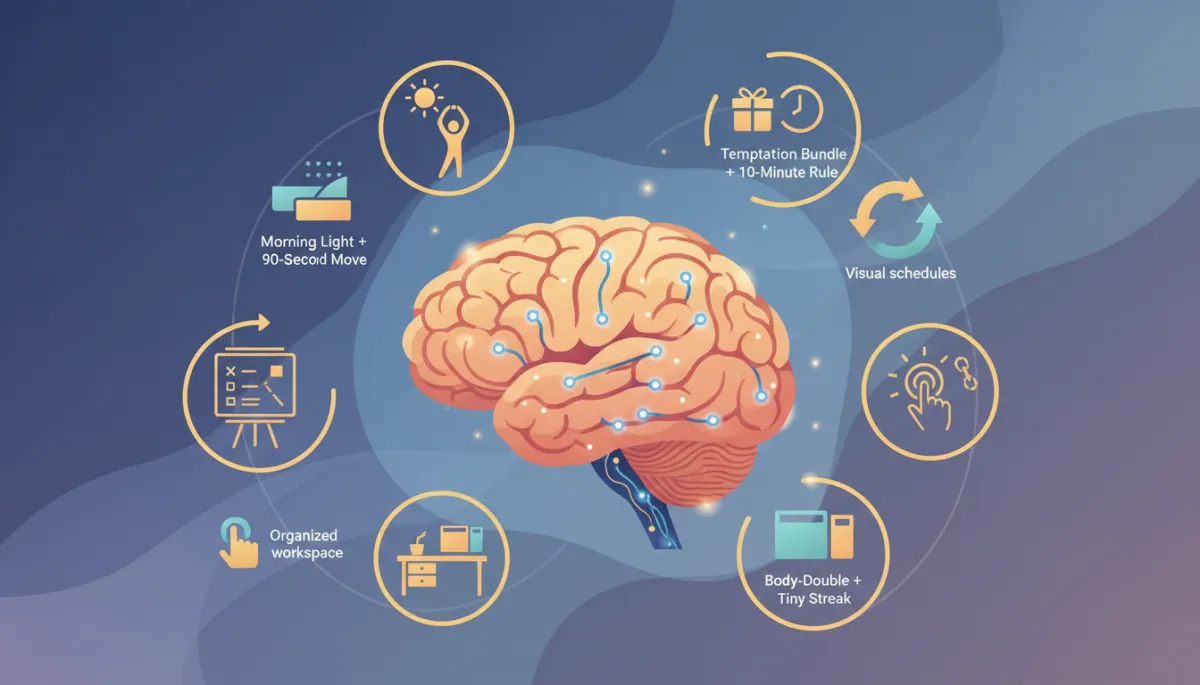
ADHD and Dopamine: Effective Strategies for Focus
ADHD, Dopamine, Executive Function, Focus, Compassionate Support
ADHD, Dopamine, and Getting Things Done (in Plain English)
A therapeutic, compassionate guide to understanding your ADHD brain and using simple, science-informed strategies to actually get things done—without shame or burnout.
Your ADHD Brain Is Not Broken
Living with ADHD can feel like having a powerful engine with tricky brakes and a steering wheel that sometimes disconnects. You may care deeply about your goals and still struggle to start, stay focused, or finish. This is not laziness or a character flaw. It is about how your brain handles dopamine and executive function.
In plain English, dopamine is a brain chemical that helps you feel motivated, interested, and rewarded. Executive function is the “manager” part of your brain that plans, organizes, starts tasks, shifts between them, and keeps track of time. In ADHD, these systems work differently. You often need more interest, more urgency, or more support to get going and keep going. That is not your fault. It just means you need different tools.
📌 Key Idea: ADHD is a difference in how your brain manages motivation and attention, not a lack of willpower.
ADHD Strategies That Respect Your Brain
Many people with ADHD have been told to “just try harder” or “be more disciplined.” That advice ignores how ADHD actually works. Helpful ADHD strategies do not fight your brain; they work with your brain’s need for dopamine, structure, and gentle support. Below are practical tools you can use in daily life, written in plain language and grounded in compassion, not criticism.
Dopamine Motivation: Why Starting Is So Hard
If you have ADHD, you may notice you can focus deeply on something you love, but simple tasks like answering emails or folding laundry feel impossible. This is often about dopamine. Boring, confusing, or overwhelming tasks do not give your brain much dopamine, so they feel heavier and harder to start. Your brain is not refusing on purpose; it is searching for something that feels more rewarding or less threatening right now.
The good news is that you can gently “nudge” your dopamine system with small, kind changes. You do not need to force yourself with shame. You can add interest, movement, connection, or tiny wins to help your brain get the spark it needs to begin. The next sections share specific dopamine-friendly strategies: Morning Light + 90-Second Move, Temptation Bundle + 10-Minute Rule, and Body-Double + Tiny Streak.
Morning Light + 90-Second Move: Waking Up Your Brain Kindly
Mornings can be especially hard with ADHD. Your brain may feel foggy, heavy, or scattered. The Morning Light + 90-Second Move strategy is a gentle way to turn on your brain’s “wake up” systems without harsh pressure. It uses two powerful tools: natural light and short movement. Both can help your body release dopamine and other helpful chemicals that support mood, focus, and energy.
Step 1: Morning Light. Within the first hour of waking, open your curtains or step outside for a few minutes. Look toward (not directly at) the daylight. Even on cloudy days, natural light sends a strong “time to be awake” signal to your brain and body.
Step 2: 90-Second Move. Add a tiny burst of movement. This can be 90 seconds of stretching, marching in place, shaking out your arms, or walking down the hall and back. You are not doing a full workout; you are just “stirring” your nervous system in a kind way.
💡 Pro Tip: Keep it embarrassingly small. The goal is not fitness. The goal is to send your brain a gentle “we are up and moving” message.
Over time, this short routine can become part of your daily ADHD strategy. It supports executive function by giving your brain a more stable starting point. You may notice it becomes a little easier to start the first task of the day when your body has had light and movement instead of going straight from bed to screen.
Temptation Bundle + 10-Minute Rule: Making Boring Tasks Less Painful
Many ADHD brains struggle with tasks that feel boring, unclear, or emotionally loaded. You might stare at the sink full of dishes or the unopened bill and feel frozen. The Temptation Bundle + 10-Minute Rule is a kind way to lower the wall between you and the task, using dopamine in your favor instead of against you.
Temptation Bundle: Pair a “Have To” With a “Want To”
A temptation bundle means you pair a task you tend to avoid with something you genuinely enjoy. The fun activity becomes a source of dopamine that makes the boring task more bearable. For example:
Only listen to your favorite podcast while folding laundry.
Sip a special tea or coffee only while sorting your inbox.
Put on a cozy playlist only when you are doing paperwork.
This is not bribing yourself. It is supporting your dopamine system so the task does not feel so empty or punishing. Your brain gets a bit of “this is nice” mixed in with “this is hard,” which makes task initiation more possible.
The 10-Minute Rule: Shrinking the First Step
The 10-Minute Rule says: “I only have to do this for ten minutes.” Set a timer for 10 minutes and tell yourself you are allowed to stop when it goes off. This helps your brain feel safer. Instead of facing a huge, endless task, you are facing a small, clear block of time. That is much easier for executive function to handle.
💡 Pro Tip: If ten minutes feels too big, start with five. The point is to lower the pressure, not to impress anyone.
Often, once you get through those first few minutes, your brain finds a bit of momentum. If you stop after ten, you still win. You practiced task initiation, which is a core ADHD skill. If you keep going, that is a bonus, not a requirement.
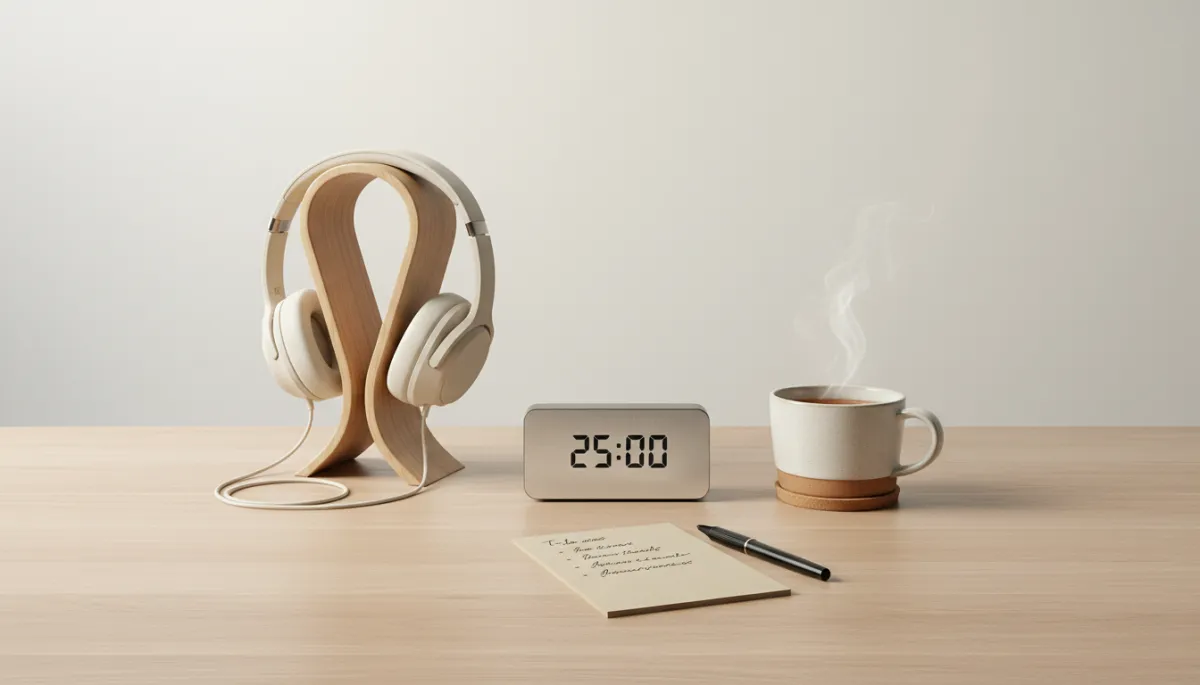
Pairing a timer with something pleasant makes starting tasks feel safer and lighter.
Body-Double + Tiny Streak: You Do Not Have to Do It Alone
ADHD often makes it hard to hold yourself accountable in your own head. A body-double is a person who is simply present—either in the same room or on video—while you work. They do not have to help with the task. Their calm presence helps your nervous system feel anchored and less alone, which can make focus and task initiation easier.
Sit next to a friend while you both work on your own projects.
Join an online “focus room” where people quietly co-work on video.
Ask a partner or roommate to be in the room while you start a hard task.
To make this even more powerful, pair it with a Tiny Streak. A tiny streak is a very small, repeatable action you do most days to build a sense of “I am someone who shows up.” For example, “I work on my project for five minutes while on a body-double call” or “I clear one item off my desk each day.” You track your streak on a calendar or app, not to chase perfection, but to notice your effort.
📌 Key Idea: Body-double + Tiny Streak supports both dopamine (through connection and small wins) and executive function (through structure and repetition).
Executive Function Supports: Making Tasks Kinder to Your Brain
Executive function is like the project manager of your brain. When it is overloaded, even simple things feel huge. Instead of blaming yourself, you can change the environment around the task. The following supports—visual schedules, task breakdown, an organized workspace, modeling task initiation, and routines—are not about being rigid. They are about reducing the mental load so your brain has less to juggle at once.
Visual Schedules: Let the Wall Remember for You
A visual schedule is a simple way to show your day or your routine in pictures or short words. Instead of keeping everything in your head, you put it where you can see it. This helps with time management, transitions, and focus.
Use a whiteboard with a list of your main blocks for the day.
Create a simple morning or evening routine card with 3–5 steps.
Use icons or color-coding if pictures help you more than words.
Visual schedules are especially helpful for kids with ADHD, but many adults find them freeing as well. They are not childish; they are assistive tools for a brain that processes information visually and can easily lose track of the next step.
Task Breakdown: Turn Mountains into Pebbles
“Clean the kitchen” is not one task. It is a cluster of many small tasks: clear the counter, put dishes in the sink, load the dishwasher, wipe the stove, and so on. For an ADHD brain, a big vague task feels like a mountain. Task breakdown means you rewrite that mountain as a list of tiny, clear steps that your brain can actually approach.
Start each step with a clear verb: “put,” “open,” “write,” “send,” “wipe.”
Make steps as small as needed: “Open laptop,” “find document,” “write first sentence.”
Cross off each tiny step to give your brain a quick dopamine hit of “done.”
💡 Pro Tip: If you feel stuck, your task is probably still too big or too vague. Shrink it again.
Organized Workspace: Make the Next Step Obvious
An “organized workspace” for ADHD does not mean Pinterest-perfect. It means your space makes the next step visible and easy. Clutter can pull your attention in many directions at once. A few simple changes can support focus and reduce decision fatigue.
Keep only the tools you need for the current task on your desk.
Use trays or bins labeled “Now,” “Later,” and “To File” instead of big piles.
Create a small “launch pad” near the door for keys, bag, and essentials.
When your workspace is set up to guide your attention, your executive function has less sorting and searching to do. That leaves more energy for focus and follow-through.
Modeling Task Initiation: Show, Do Together, Then Support
If you are a parent, partner, teacher, or friend supporting someone with ADHD, one of the most powerful gifts you can offer is modeling task initiation. Instead of simply telling them to start, you can show what starting looks like, then do it with them, and slowly step back as they gain confidence.
Say out loud: “I am going to put the first three dishes in the dishwasher. Want to do the next three with me?”
For a child: “Watch me write the first sentence. Now you write the next one, and I will sit with you.”
For a partner: “Let’s both set a 10-minute timer and start our own tasks at the same time.”
Modeling task initiation teaches the brain, “This is how we begin,” in a low-pressure way. It also adds social connection and compassion, which can soften shame and fear around starting.
Routines: Gentle Rails, Not Rigid Rules
Many people with ADHD have a complicated relationship with routines. You may crave structure but feel trapped by strict schedules. Think of routines as gentle rails that guide your day, not rigid rules you must obey perfectly. Simple, repeatable patterns reduce the number of decisions your executive function has to make from scratch.
A morning routine might be: light + 90-second move, drink water, check visual schedule.
An evening routine might be: quick tidy of one surface, set out clothes, plug in devices in the same spot.
A work-start routine might be: clear desk, open calendar, write three tiny steps for the day.
💡 Pro Tip: Build routines around what already happens—like waking up, eating, or coming home—so you are adding small supports to existing anchors.
Focus Techniques That Are ADHD-Friendly
Traditional focus advice often assumes a brain that can sit still and pay attention on command. ADHD brains usually need more movement, more breaks, and more variety. Here are some focus techniques that often work better for ADHD:
Use shorter focus blocks (10–20 minutes) with planned breaks, instead of long marathons.
Allow quiet fidgets (like a stress ball or gentle rocking) to help your body self-regulate while you work.
Use background noise (like brown noise or soft music) if silence makes your mind wander more.
Keep your main task visible (a sticky note on your screen) so your attention has a place to return to when it drifts.
These techniques respect that your attention may move in waves. Instead of fighting the waves, you are giving yourself a surfboard: structure, tools, and compassion to ride them more smoothly.
Compassionate Support: Shame Blocks, Kindness Unlocks
All the ADHD strategies in the world will feel heavier if they are wrapped in shame. Compassion is not a “nice extra”; it is a core part of effective support. When you speak to yourself with harshness—“What is wrong with me? Why can’t I just do this?”—your nervous system goes into threat mode. In that state, executive function and dopamine both struggle. Kindness, on the other hand, helps your brain feel safer, which makes it easier to try again.
Replace “I am so lazy” with “My ADHD brain is stuck; what small support could help?”
Notice effort, not just results: “I set a timer and did five minutes. That matters.”
Offer the same tone to yourself that you would to a close friend or a child you care about.
If you are supporting someone with ADHD, your compassionate support can sound like:
“I see you are overwhelmed. Do you want a body-double while you start?”
“This task is a lot. Want to break it into steps together?”
“You are not failing. Your brain just needs different tools. Let’s try one.”
Putting It All Together: A Gentle Example Day
Here is how these ADHD strategies, dopamine supports, executive function tools, focus techniques, task initiation methods, and compassionate support might look woven into one ordinary day:
You wake up and do Morning Light + 90-Second Move to gently turn on your brain.
You glance at your visual schedule to see the three main blocks of your day.
At work, you break down a big project into five tiny steps and clear your desk so only what you need is visible, creating an organized workspace.
You use a Temptation Bundle + 10-Minute Rule to answer emails: favorite playlist on, timer set for ten minutes, permission to stop afterward.
In the afternoon, you join a friend on a body-double video call, and you both work quietly on your own tasks for short focus blocks, building your Tiny Streak of “I show up for my work most days.”
In the evening, you follow a short routine: tidy one surface, set out tomorrow’s clothes, plug in your devices at the same spot, then rest.
Throughout the day, you practice speaking to yourself with compassionate support instead of blame. When you get stuck, you do not ask, “What is wrong with me?” You ask, “What support would help my ADHD brain right now—more dopamine, more structure, or more kindness?”
You Deserve Tools, Not Judgment
ADHD, dopamine, and executive function can sound complicated, but the heart of it is simple: your brain is wired differently, and it needs different kinds of help to get things done. Strategies like Morning Light + 90-Second Move, Temptation Bundle + 10-Minute Rule, and Body-Double + Tiny Streak are not tricks to force you into someone else’s idea of productivity. They are ways to work with your real brain, in real life, with respect.
When you combine these motivation strategies with executive function supports—visual schedules, task breakdown, an organized workspace, modeling task initiation, and gentle routines—you create an environment where your ADHD brain can actually breathe. Focus techniques become less about “try harder” and more about “let’s make this possible.”
You are not behind. You are not broken. You are learning how your unique brain works and how to offer it what it needs: structure, dopamine, and above all, compassion. That is not cheating. That is care.
