ADHD, Dopamine & Motivation: Strategies Explained
ADHD, Dopamine Motivation, Executive Function, Compassionate Support
ADHD, Dopamine, and Getting Things Done (in Plain English)
If you live with ADHD (or love someone who does), you probably know this story: the task is important, you genuinely care, you might even feel stressed about it—and yet you still cannot seem to start. This is not laziness or a character flaw. It is about how the ADHD brain, dopamine, and executive function work together. Let’s walk through it in friendly, plain English and explore ADHD strategies, focus techniques, and compassionate support that actually help you get things done.
How ADHD Brains Are Wired for Motivation (Not Just Willpower)
To understand ADHD strategies that actually work, it helps to know one big idea: the ADHD brain is interest-based, not just “importance-based.” Most people can do a task because it is important or because they “should.” For ADHD brains, importance alone often is not enough to flip the “go” switch. That switch is closely tied to dopamine motivation.
Dopamine is a brain chemical that helps with motivation, reward, and focus. In ADHD, the dopamine system tends to be less consistent. That means tasks that are boring, long, or unclear do not give enough dopamine to get started—no matter how much you care. On the other hand, interesting, urgent, or emotionally intense tasks can light up the brain and make focus feel almost effortless. If you have ever pulled an all-nighter on a project you started at the last minute, you have experienced this dopamine surge in action.
💛 Gentle reminder: Struggling to start or finish tasks with ADHD is not a moral failure. It is a brain wiring difference. We are going to work with that wiring, not against it.
Executive Function: Your Brain’s “Project Manager”
Another key piece is executive function. Think of executive function as your brain’s project manager. It helps you:
Plan what needs to happen and in what order
Start tasks (this is called task initiation)
Stay focused and filter out distractions (your focus techniques live here)
Switch between tasks and adjust when plans change
Hold information in mind long enough to use it (working memory)
With ADHD, these executive function skills can be wobbly, especially under stress or boredom. That is why “just try harder” does not work. Instead, we build supports around the brain—like visual schedules, routines, and an organized workspace—to make the project manager’s job easier. Then we add dopamine nudges to help your motivation system actually turn on.
Three Gentle Dopamine Nudges to Help You Get Started
Let’s look at three simple, science-informed ADHD strategies that give your brain small dopamine boosts so you can move from frozen to “okay, I can do this.” Each one is designed to be practical, kind, and doable even on low-energy days.
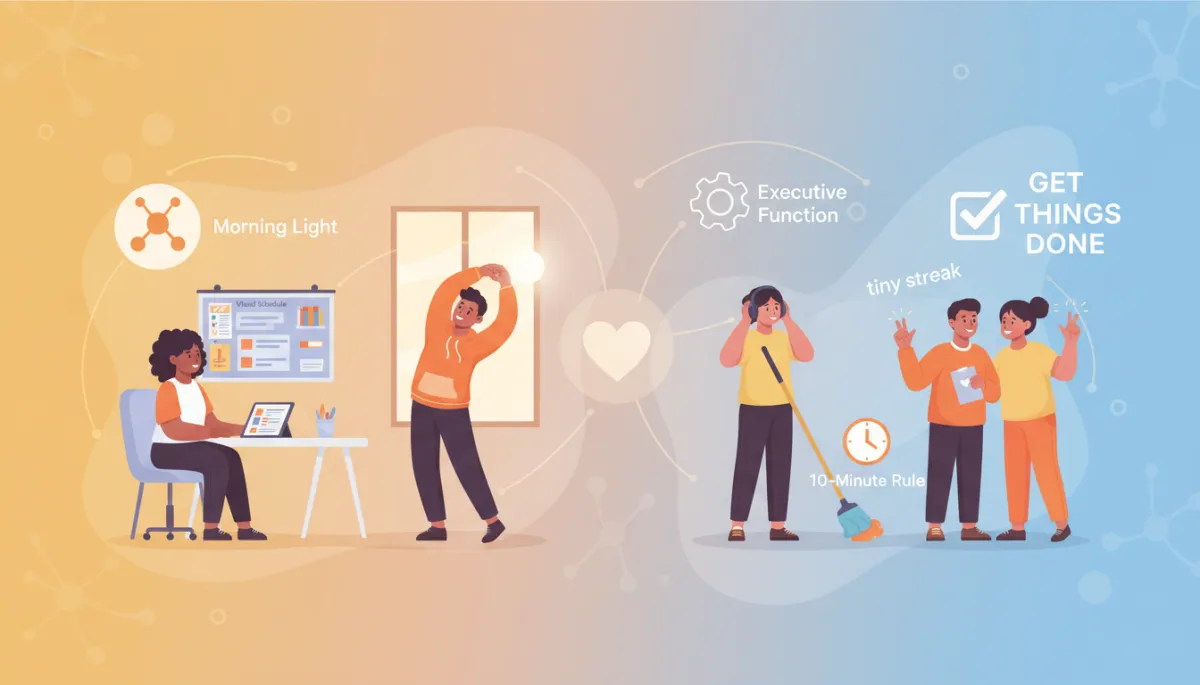
1. Morning Light + 90-Second Move
Your brain loves cues that say, “It is time to wake up and focus.” Two powerful cues are natural light and movement. This focus technique is short, gentle, and surprisingly effective:
As soon as you reasonably can, get some morning light. Open the blinds, step onto a balcony, or sit near a window for a few minutes. If that is not possible, turn on brighter indoor lights.
Pair it with a 90-second move: gentle stretching, walking in place, a quick dance to one song, or pacing while you sip coffee or water.
Light and movement together help regulate your body clock, wake up your brain, and give a small dopamine lift. You are not “fixing” ADHD here; you are just nudging your nervous system toward “ready enough” so task initiation feels a tiny bit more possible. On days when everything feels heavy, think of this as your gentle “start-up routine,” not another thing to fail at. If all you do is open the curtains and roll your shoulders, that still counts.
2. Temptation Bundle + 10-Minute Rule
Remember that ADHD brains are interest-based? Temptation bundling is an ADHD strategy that uses this to your advantage. The idea is simple: pair something you want to do with something you are avoiding. Then add the 10-minute rule to lower the pressure even more.
Listen to your favorite podcast only while doing dishes or folding laundry.
Sip a special drink you love while answering emails.
Save a cozy playlist for homework time or bill-paying time.
Then bring in the 10-minute rule: tell yourself you only have to do the task for 10 minutes. Set a timer. When the timer goes off, you can stop with zero guilt. If you feel like continuing, great—that is a bonus, not a requirement. This structure adds dopamine motivation in two ways: the reward you paired with the task and the relief of knowing you are not trapped for hours. Your brain hears, “Just a small, safe step,” instead of “This will be awful and endless.”
💡 Compassionate tip: If 10 minutes feels like too much, make it 5. The number is flexible. The goal is to make starting feel possible, not perfect.
3. Body-Double + Tiny Streak
A body double is someone who is simply present—online or in person—while you work. They do not have to help with the task. Their presence adds gentle social pressure and connection, which can boost dopamine and make focus easier. This is one of the most beloved ADHD focus techniques because it reduces the loneliness and overwhelm of doing hard things alone.
Study with a friend on video while each of you does your own work.
Ask a partner, roommate, or child to sit nearby while you tackle paperwork.
Join virtual “focus rooms” or co-working sessions where people work quietly together.
Now add the tiny streak piece. Choose one very small, repeatable action you can do most days. For example, “open my planner,” “put one dish in the dishwasher,” or “write one sentence.” Track it on a simple calendar or app. Celebrate every day you do it, even if you do only that tiny action. The streak gives a visual “I am doing it” reward, which feeds dopamine motivation and builds trust in yourself over time.

Working alongside someone else can gently boost focus and reduce task avoidance.
Building Executive Function Supports Around Your Brain
Dopamine nudges help you get moving. To keep life manageable, you also need executive function supports—practical structures that hold some of the planning, remembering, and organizing outside your head. This is not cheating. It is smart design for an ADHD brain. Let’s walk through some of the most helpful supports: visual schedules, task breakdown, an organized workspace, modeling task initiation, and routines.
Visual Schedules: Making Time Visible
Many people with ADHD struggle with “time blindness”—the feeling that time is either “now” or “not now.” A visual schedule makes time more concrete. This can be as simple or creative as you like:
A whiteboard with today’s top 3 tasks and when you will do them
A paper planner with colorful blocks for work, rest, and fun
Picture schedules for kids, showing morning, school, and evening routines
The goal is not a perfect, Instagram-ready layout. It is to give your brain a gentle map: “Here is what is happening, and here is when.” This reduces anxiety, supports task initiation, and frees up mental energy for actually doing the tasks.
Task Breakdown: Shrinking the Mountain into Pebbles
ADHD brains often see big tasks as one overwhelming mountain. Task breakdown is the skill of turning that mountain into small, doable pebbles. Instead of “clean the house,” you might write:
Put dirty dishes in sink
Throw away visible trash in living room
Start one load of laundry
For school or work projects, break it down into “open document,” “brainstorm ideas,” “write rough outline,” and so on. Each small step becomes a separate win and a separate chance for dopamine motivation. If breaking tasks down is hard for you, it is okay to ask for help. A friend, partner, or coach can sit with you and help you turn “do project” into a simple list. That is compassionate support in action.
Organized Workspace: Less Visual Noise, More Brain Space
An “organized workspace” does not mean spotless or minimalist. It means that the things you need are easy to find, and the things you do not need right now are not shouting at your attention. ADHD brains are extra sensitive to visual clutter, which can drain focus and executive function quickly. Try:
Having one small “today” tray or basket for current papers or supplies
Using clear bins or labeled folders so your brain trusts that things are not “lost forever”
Doing a 5-minute reset at the end of the day: put items back in their homes, clear one small surface
If organizing feels overwhelming, remember: your space does not have to look like anyone else’s. You are creating a supportive environment for your unique brain, not auditioning for a magazine spread.
Modeling Task Initiation: “Let’s Start Together”
If you are supporting a child, teen, partner, or friend with ADHD, one of the kindest things you can do is model task initiation. Instead of saying, “Go clean your room,” try:
“Let’s start together for 5 minutes. I’ll help you pick up clothes, and then you can keep going or take a break.”
“I’m going to open my laptop and answer one email. Do you want to sit with me and open your homework?”
You are not only helping in the moment; you are showing what “getting started” looks like in tiny, manageable steps. This is powerful executive function coaching, wrapped in compassionate support. Over time, the person with ADHD can internalize this pattern and use it on their own: “Okay, I do not have to finish. I just have to start one tiny piece.”
Routines: Gentle Autopilot for a Busy Brain
Routines often get a bad reputation as rigid or boring, but for ADHD, simple routines can be a form of self-kindness. A routine is just a pattern you repeat often enough that your brain needs less energy to remember what to do. Think “gentle autopilot,” not “strict schedule.”
A morning routine might be: bathroom, morning light + 90-second move, drink water, check visual schedule.
An evening routine might be: 5-minute tidy, set out tomorrow’s clothes, plug in devices, tiny streak action.
Routines are especially helpful for things you do every day but often forget, like taking medication, packing a bag, or checking a calendar. Write them down, post them where you can see them, and be kind to yourself when life gets messy. Routines are tools, not tests.
📌 Key takeaway: Every support you build—visual schedules, task breakdown, organized spaces, routines—is there to lighten the load on your executive function, so your energy can go toward living your life, not just managing it.
Putting It All Together: A Compassionate ADHD Day-in-the-Life
Let’s imagine how these ADHD strategies, focus techniques, and executive function supports might look in a real day. This is just an example—you can mix and match what fits your life.
Morning: You open the blinds and do a gentle 90-second stretch while your coffee brews. That is your Morning Light + 90-Second Move. Then you glance at your visual schedule on the fridge: work block, lunch, short walk, afternoon tasks, evening rest. You circle your top 2 priorities instead of trying to do everything.
Mid-morning: You have been avoiding email. You set up a Temptation Bundle: favorite playlist + 10-minute rule. You tell yourself, “Only 10 minutes of inbox while I listen to this album.” Once the timer rings, you are pleasantly surprised that you are willing to finish one more message—but you also know you are allowed to stop.
Afternoon: A bigger project feels overwhelming, so you text a friend: “Want to co-work on Zoom for 30 minutes?” You both log on, say hello, and then mute while you each work. That is your Body-Double + Tiny Streak time. You open the project file (tiny streak win!), and break the task into three steps on a sticky note.
Evening: You do a 5-minute reset in your workspace: clear the desk, put pens back, place tomorrow’s to-do list in the “today” tray. Then you follow your simple evening routine. If something falls through the cracks, you remind yourself: “This is a work in progress. My brain is doing its best.”
None of this requires superhuman discipline. It is about understanding how your brain works—dopamine motivation, executive function, and task initiation—and building a life that supports it with compassion instead of criticism.
A Final Word of Compassionate Support
Living with ADHD often means carrying years of messages like “You are so smart, why cannot you just do it?” or “You are lazy,” or “You are too much.” Those messages are heavy, and they are also incomplete. They ignore the real story: an ADHD brain doing its best with a different wiring for motivation and executive function.
When you use ADHD strategies like Morning Light + 90-Second Move, Temptation Bundle + 10-Minute Rule, and Body-Double + Tiny Streak, you are not “cheating the system.” You are honoring how your brain actually works. When you build visual schedules, break tasks down, create a more organized workspace, model task initiation, and lean on routines, you are giving your executive function the scaffolding it deserves. This is what compassionate support looks like in everyday life.
You are allowed to ask for help. You are allowed to try tools and then change them. You are allowed to celebrate tiny wins: opening the planner, sending one email, putting one dish away. Each of these is a moment of courage in a brain that has been told it is “too much” or “not enough” for far too long.
As you experiment with these focus techniques and executive function supports, keep the tone with yourself as gentle as you would with a dear friend: curious, patient, and kind. Your ADHD brain is not broken. It is simply wired differently, and with the right structures and dopamine nudges, it can do incredible things—one compassionate step at a time.
