
Sound Mapping: Mindfulness & Nervous System Regulation
Mindfulness, Grounding Techniques, Nervous System Regulation
Sound Mapping: A Gentle Way to Come Back to Yourself
When your mind is racing or your body feels on edge, it can be hard to simply “take a deep breath” and relax. Sound Mapping offers a soft, accessible way to return to your body, your breath, and the present moment—one sound at a time. This simple mindfulness practice uses everyday sounds as anchors for grounding, nervous system regulation, and present moment awareness, inviting you to meet yourself with curiosity and self-compassion instead of pressure or force.
What Is Sound Mapping?
Sound Mapping is a simple, structured listening exercise where you gently notice and “map” the sounds around you, either mentally or on paper. Instead of trying to block out noise, you turn toward it with mindful attention. You might notice the hum of a refrigerator, a car passing outside, a bird call, the creak of a chair, or the sound of your own breath. Each sound becomes a point on an invisible map, helping you orient in time and space and come back to yourself in a grounded, embodied way.
Unlike practices that ask you to change or control your experience, Sound Mapping invites you to observe what is already happening. This makes it especially supportive for people whose nervous systems are easily overwhelmed, or for those who find traditional meditation intimidating. It is a form of mindfulness practice that emphasizes gentleness, accessibility, and respect for your current capacity.
Why Grounding Techniques Matter for Your Nervous System
Grounding techniques are strategies that help you reconnect with your body, your environment, and the here-and-now when you feel anxious, numb, dissociated, or overwhelmed. They are tools that support nervous system regulation, giving your body cues that you are safe enough in this moment to soften, orient, and breathe. Rather than pushing feelings away, grounding helps you create a stable base from which you can feel, think, and respond more clearly.
Our bodies are wired to scan for danger. When we are stressed, our attention narrows and fixates on threats—real or imagined. Grounding practices like Sound Mapping gently widen your attention again. By bringing awareness to concrete sensory details, you send a message to your nervous system: “Right now, I am here. I can notice. I can choose how to respond.” Over time, this builds capacity for resilience and supports more flexible nervous system states, rather than staying stuck in fight, flight, or freeze.
The Power of Gentle, Accessible Tools for Regulation
Many people have been told to “just meditate” or “just breathe” when they feel overwhelmed. While these suggestions are well-intentioned, they can sometimes feel invalidating or unrealistic. When your heart is pounding or your thoughts are spiraling, it may not feel possible to sit still in silence or follow a long guided meditation. This is where gentle, accessible tools for nervous system regulation become essential. They meet you where you are, without demanding that you instantly relax or focus perfectly.
Sound Mapping is one of these tools. You do not need special equipment, a quiet room, or a long block of time. You can practice for thirty seconds or ten minutes. You can do it sitting, standing, or even while walking slowly. Because the practice is based on present moment awareness of sound, it uses what is already available: the soundscape of your current environment. This makes it especially supportive for people who want practical, real-world grounding techniques they can use at home, at work, or on the go.
💡 Gentle Reminder: The goal of Sound Mapping is not to become perfectly calm. The goal is to offer your nervous system a soft landing place, even if only for a few moments at a time.
How to Practice Sound Mapping: Step-by-Step
You can think of Sound Mapping as a series of simple listening exercises. Below is one way to practice. Feel free to adjust the steps so they feel natural and kind to your system.
Step 1: Arrive and Orient Gently
Start by choosing a position that feels reasonably comfortable—sitting, standing, or lying down. Let your eyes rest on a neutral point in front of you or close them if that feels safe. Take a moment to notice a few points of physical contact: your feet on the floor, your back against a chair, your hands resting on your lap. There is no need to change anything; simply acknowledge that your body is here, right now, supported by gravity and the surfaces beneath you.
Step 2: Invite Your Attention to Sound
Next, gently invite your attention toward the sounds around you. You are not searching for anything special—just letting sounds come to you. Notice the closest sound you can hear. Then notice something a little farther away. Let your awareness move outward, as if you were slowly zooming out on a map, including more and more of the soundscape without needing to label anything as good or bad.
Step 3: “Map” the Sounds You Notice
As you listen, begin to “map” what you hear. You can do this silently in your mind or by jotting down brief notes. For example:
“Soft whirring of the fan to my left”
“Distant traffic outside the window”
“Birdsong high and to the right”
“My own breath, soft and steady”
You might imagine yourself drawing a circle around you and placing each sound at its approximate location. Or you might simply list sounds in the order you notice them. The key is to stay curious: What else can I hear right now?Where does that sound seem to come from?Is it constant or changing? This gentle curiosity is a core part of Sound Mapping as a mindfulness practice.
Step 4: Include Your Inner Soundscape
Once you feel settled with external sounds, you can optionally bring awareness to “inner” sounds: your breath, your heartbeat (if you can feel it), your swallowing, or even the subtle sounds of your clothing shifting. This is also a way of inviting present moment awareness of your body without forcing a particular sensation. If it feels supportive, you might silently name: “In-breath,” “Out-breath,” “Swallow,” or “Heartbeat,” placing them on your internal sound map with the same non-judgmental curiosity.
Step 5: Close with Self-Compassion
After a few minutes (or whatever length feels right), slowly bring your attention back to your surroundings. Notice once again the contact points of your body, the weight of your hands, the support beneath you. Take a moment to acknowledge yourself for pausing, even if it felt imperfect or distracted. You might say silently, “Thank you for trying this,” or, “That was enough for now.” This self-compassionate closing helps your nervous system associate Sound Mapping with safety and kindness, rather than performance or pressure.
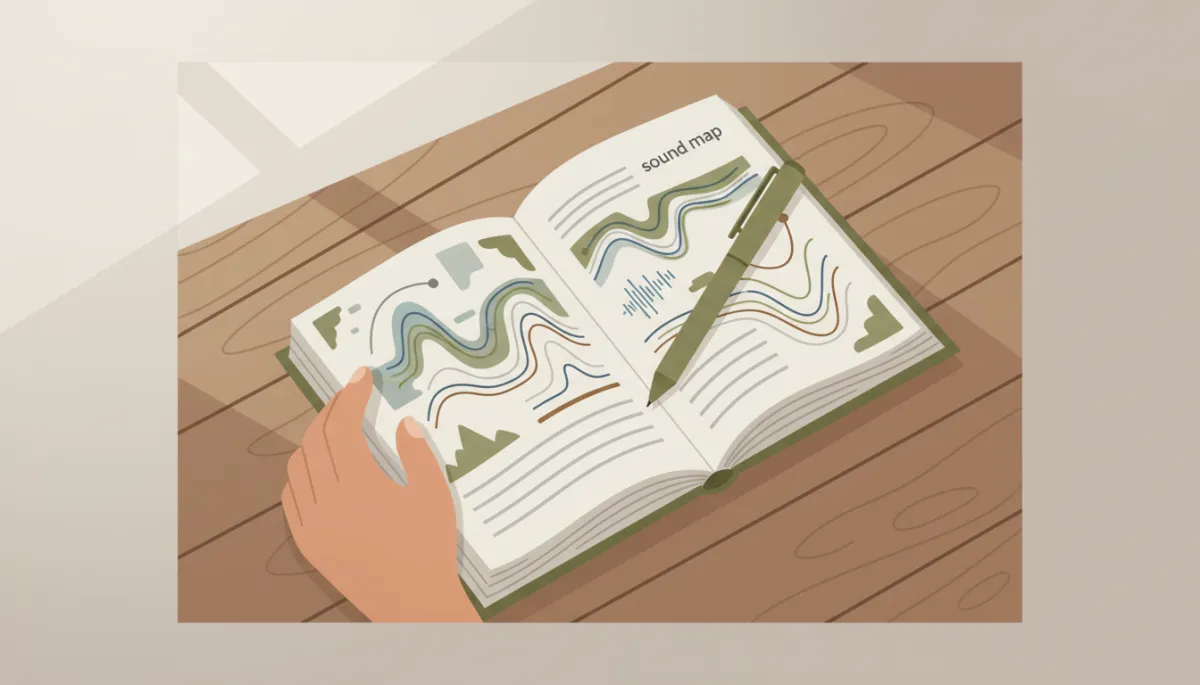
Writing down sounds can deepen focus, but the practice works just as well in your mind.
Why Sound Mapping Works: A Nervous System Perspective
From a nervous system perspective, Sound Mapping supports regulation in several key ways. When you intentionally tune into sound, you are engaging your orienting response—the natural impulse your body has to scan the environment for cues of safety or danger. In stressful moments, this orienting can become rigid or hyper-focused on threat. Sound Mapping invites a more flexible, curious kind of orienting, where you notice not only potential alarms but also neutral and pleasant sounds that indicate safety and stability.
This practice also engages the present moment awareness networks in your brain, shifting you away from rumination about the past or worries about the future. By gently anchoring your attention in sensory detail, Sound Mapping interrupts spirals of anxious thinking without demanding that you “stop thinking.” Instead, your attention is invited to land somewhere else—on the hum of the heater, the ticking of a clock, the distant murmur of voices. These neutral anchors can help your system gradually move from high activation toward a more regulated state, or from numbness toward gentle re-engagement with your surroundings.
Additionally, the auditory system is closely connected to the vagus nerve, which plays a central role in nervous system regulation. Certain sounds—like steady, predictable background noise or soft natural sounds—can cue the body toward a more settled, socially engaged state. By bringing mindful attention to these sounds, you are not only hearing them but also allowing their regulating qualities to register more fully in your body. Over time, Sound Mapping can help you recognize which sound environments feel supportive and which tend to agitate or drain you, giving you more choice in how you care for your system.
📌 Key Takeaway: Sound Mapping works because it harnesses your body’s natural orienting response, guiding it toward safety and curiosity instead of threat and shutdown.
What Clients Often Notice When They Practice Sound Mapping
People who integrate Sound Mapping into their mindfulness practice frequently report a few common experiences. Your own process will be unique, but these themes might feel familiar or encouraging as you explore the practice yourself.
1. A Subtle Softening in the Body
At first, some people notice that their shoulders drop a little, their jaw loosens, or their breath becomes slightly deeper without effort. Even if their thoughts remain busy, the body begins to receive the message that it is safe enough to release a bit of tension. This softening may be very subtle, but over time it can accumulate into a felt sense of greater ease and groundedness in daily life.
2. A Shift from “Noise” to “Information”
Clients often say that environments that once felt overwhelmingly noisy begin to feel more manageable when approached through Sound Mapping. Instead of one big wall of sound, they start to notice distinct layers: the closest sound, the farthest sound, the constant hum, the occasional interruption. This shift—from undifferentiated “noise” to specific, nameable sounds—can reduce the sense of chaos and support more regulated present moment awareness.
3. Increased Curiosity and Less Self-Judgment
Because Sound Mapping is framed as an experiment in noticing, many people find it easier to stay curious and less critical of themselves. Instead of thinking, “I’m bad at meditating,” they might think, “Interesting, my attention keeps jumping to that car alarm,” or, “I notice I feel calmer when I focus on the birds instead of the traffic.” This gentle curiosity is itself a form of nervous system regulation, replacing harsh inner commentary with a more compassionate, observational stance.
4. A Stronger Sense of “Being Here”
Over time, regular Sound Mapping can deepen your sense of being anchored in your body and your surroundings. Clients sometimes describe this as feeling “more here,” “less floaty,” or “more connected to the room I’m in.” This is the heart of many grounding techniques: helping you feel that you exist in a specific place, at a specific time, with specific sensations, rather than feeling lost in an abstract swirl of thoughts or emotions.
Modifying Sound Mapping When It Feels Difficult or Overstimulating
While Sound Mapping is a gentle practice, it may not always feel easy—especially in loud or chaotic environments, or if your nervous system is already highly activated. It is completely valid to adjust the practice so that it feels safer and more accessible. In fact, adapting grounding practices to your own needs is a powerful act of self-care and self-trust.
If Your Environment Is Very Noisy or Overstimulating
In busy public spaces or loud households, Sound Mapping might initially feel like “too much.” Here are a few ways to modify it:
Use headphones with gentle, neutral sounds. If possible, put on soft instrumental music, nature sounds, or white noise, and map only those sounds. This still counts as a valid listening exercise and can be especially regulating for sensitive systems.
Limit your “map” to just one or two sounds. Instead of trying to track everything, choose a single sound—like the hum of an air conditioner—or two alternating sounds and gently rest your attention there, returning when you drift.
Pair sound with another sense. For example, hold a warm mug or feel your feet pressing into the ground while you map only the most distant sounds. This gives your nervous system two anchors instead of one, which can feel more stabilizing.
If Sound Feels Threatening or Uncomfortable
For some people, certain sounds are linked to past stress or trauma, and focusing on them may feel unsafe. In this case, it is wise to move slowly and respectfully. You might:
Choose a safe sound source. For example, a tabletop fountain, a favorite playlist, or a white noise machine. Practice Sound Mapping only with this chosen sound until your system feels more confident and settled.
Keep sessions very short. Even 20–30 seconds of mindful listening can support nervous system regulation. You can always stop if it starts to feel too intense.
Alternate with visual or touch-based grounding techniques. For instance, spend a few breaths mapping sound, then look around and name three colors you can see, or notice three points of physical contact. This weaving of senses can prevent overwhelm.
If Your Mind Feels Too Busy or You “Can’t Focus”
It is completely normal for your mind to wander during Sound Mapping. In fact, noticing that your attention has drifted is part of the mindfulness practice. When this happens, see if you can respond with curiosity instead of criticism. You might say to yourself, “Of course my mind wandered; that’s what minds do,” and then gently return to the next sound you can hear. You do not have to track every sound perfectly. Simply coming back, again and again, is the practice.
💡 Pro Tip: If focusing feels hard, try mapping just three sounds and then stopping. Celebrate that as a complete practice, not a failure.
Weaving Sound Mapping into Daily Life
One of the strengths of Sound Mapping is that it can be integrated into ordinary moments, turning them into opportunities for present moment awareness and nervous system regulation. You might:
Map sounds while waiting in line at a store, noticing the hum of refrigerators, snippets of conversation, and the beeping of scanners.
Take a brief Sound Mapping break between meetings, letting your attention rest on the quietest and farthest sounds you can detect.
Use Sound Mapping before bed, focusing on the most soothing or neutral sounds in your environment to support your body in winding down.
Practice during a walk, noticing how the soundscape shifts from block to block—birds, traffic, footsteps, wind in the trees.
These small, frequent practices can be just as powerful as longer sessions. Each time you return to Sound Mapping, you are reinforcing a pathway of gentle attention, self-compassion, and embodied presence. Over time, your nervous system learns that you have reliable, accessible tools for grounding, even when life feels unpredictable or intense.
Bringing It All Together: A Gentle Invitation
Sound Mapping sits at the intersection of grounding techniques, mindfulness practice, and nervous system regulation. It is a way of saying to yourself, “I am here, and I am listening,” even when you feel scattered or overwhelmed. By turning toward the soundscape with curiosity and care, you offer your body a chance to orient, soften, and reconnect with the present moment in a way that does not demand perfection or stillness.
You do not have to do this practice “right” for it to be helpful. You do not have to feel instantly calm or deeply meditative. Simply pausing to notice one or two sounds, to locate yourself in space and time, is enough. Over days and weeks, those small moments of present moment awareness can add up to a more spacious inner landscape, where you feel a bit more choice, a bit more steadiness, and a bit more kindness toward yourself.
If you feel called, you might set a gentle intention to experiment with Sound Mapping once a day for a week. Keep it simple. Let your practice be short, imperfect, and entirely yours. Notice what shifts—physically, emotionally, mentally—without forcing anything to change. In doing so, you are not only practicing a listening exercise; you are cultivating a relationship with yourself that is rooted in respect, curiosity, and compassion.
In a world that often pulls your attention outward and fragments your focus, Sound Mapping is a quiet invitation to come home—to your breath, your body, and the simple, steady sounds that remind you: you are here, you are alive, and you can meet this moment one gentle note at a time.
