Understanding Neurodiversity: ADHD, Autism, AuDHD Visuals
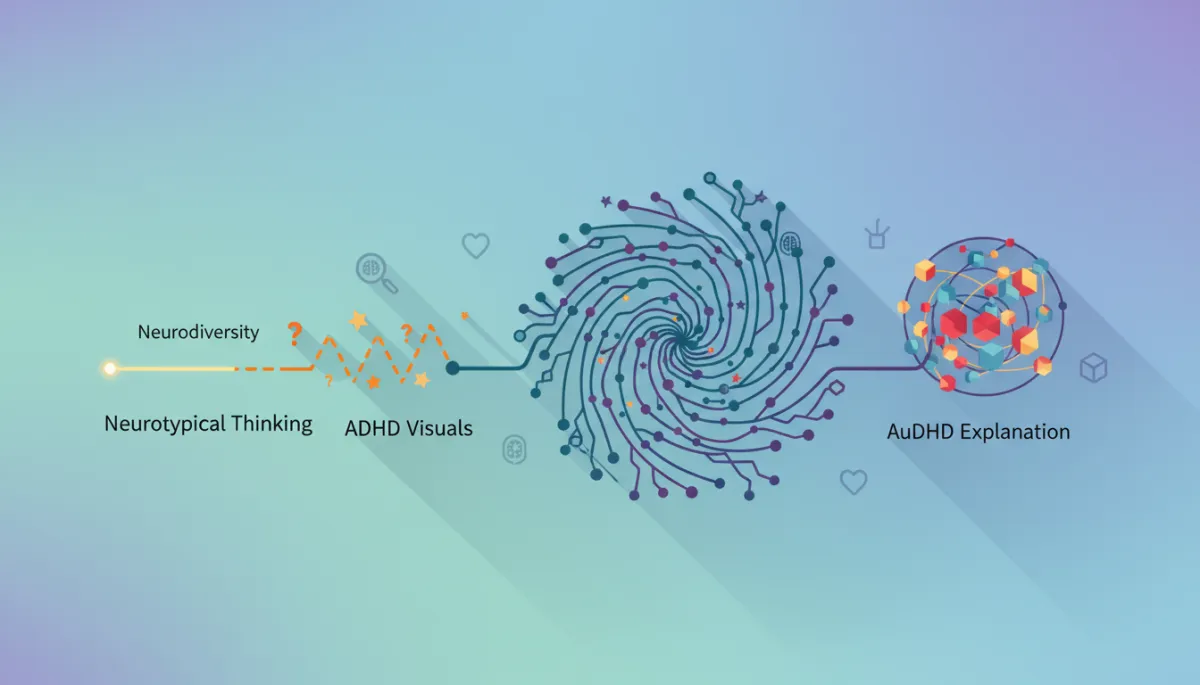
Neurodiversity, ADHD Visuals, Autism Representation, AuDHD Explanation
Understanding NT, ADHD, Autism, and AuDHD Through Simple Visuals
Neurodiversity can feel abstract and overwhelming, especially when you are trying to understand your own brain or someone you love. Simple visual metaphors can make these differences easier to grasp, not as medical labels, but as gentle ways to picture how minds work. In this guide, we will explore four visuals: a straight line for neurotypical thinking, an interrupted line for ADHD, an expanding web for autism, and organized chaos for AuDHD. These are metaphors, not diagnostic tools, and their purpose is to build understanding and compassion, never judgment.
Why Visual Metaphors Help Us Understand Neurodiversity
Neurodiversity is the idea that there is no single “normal” brain. Instead, human brains vary in how they process information, feel emotions, and respond to the world. For many people, especially visual thinkers, visual metaphors can turn invisible inner experiences into something you can see and point to. A simple drawing can communicate more than a page of clinical language, especially around ADHD visuals, autism representation, or an AuDHD explanation that actually feels relatable.
It is crucial to remember that these visuals are illustrations, not diagnoses. They cannot tell you whether you are neurotypical, ADHD, autistic, or AuDHD. What they can do is offer a shared language: a way for you to say, “My brain feels more like this drawing than that one,” and for others to respond with curiosity instead of criticism. Used this way, visual metaphors become tools for empathy and self-understanding, not boxes to squeeze yourself into.
💡 Key Reminder: These visuals are starting points for conversation about neurodiversity, not checklists for diagnosis. If you are wondering about your own neurotype, a qualified professional is the right next step.
The Straight Line: A Visual Metaphor for Neurotypical Thinking
Imagine a clean, straight line drawn from left to right across a page. It starts at one point, moves steadily, and ends exactly where it was planned to go. This is a simple metaphor for neurotypical thinking—not “better” or “worse,” just more in line with how society usually expects brains to work. The straight line represents a predictable path: you decide to do something, you focus on it, and you follow through with relatively few internal detours.
In this visual, tasks tend to follow a sequence: Step 1, Step 2, Step 3. Distractions exist, but they feel more like background noise than powerful magnets. A neurotypical person might think, “I need to send that email,” and then simply… send the email. The line from intention to action is mostly uninterrupted. That does not mean life is easy or stress-free, but it does mean that the brain’s default mode tends to cooperate with everyday expectations like schedules, deadlines, and social norms.
For someone who is not neurotypical, seeing this straight line can bring up a mix of emotions: envy, frustration, or even relief in finally understanding why certain tasks seem easier for others. The point of this metaphor is not to idealize the straight line, but to show that many systems—schools, workplaces, routines—are built assuming this kind of steady, linear path. Recognizing that helps explain why other neurotypes can feel constantly “out of sync” with expectations that were never designed for them.
The Interrupted Line: A Visual for ADHD Brains
Now picture a line that is trying to be straight—but it keeps breaking. It moves forward, stops, jumps up, zigzags, starts again, and sometimes runs off the page before looping back. This is a common ADHD visual: the interrupted line. The goal is still there, just like with the straight line. The difference is that the path is constantly pulled in different directions by competing thoughts, impulses, and external distractions.
If you live with ADHD, this metaphor might feel painfully familiar. You may sit down to complete a simple task and suddenly find yourself:
Checking your phone without realizing you picked it up
Starting three other tasks before finishing the first one
Feeling a burst of energy, then suddenly hitting a wall of exhaustion
On paper, it can look like “laziness” or “carelessness.” Through the interrupted line metaphor, you can instead see ADHD as a different way of moving through tasks: highly responsive to interest, novelty, and urgency, but easily stalled when something feels boring, overwhelming, or emotionally loaded. The line is not broken because you do not care; it is interrupted because your brain’s attention system works differently.
📌 Key Takeaway: The interrupted line reminds us that ADHD is not a moral failing. It is a pattern of attention and energy that needs different supports, not more shame.
When someone with ADHD sees their experience reflected in a simple drawing, it can be deeply validating. Instead of feeling like “everyone else can walk in a straight line, what is wrong with me?”, the metaphor offers a kinder truth: “My line looks different. That means I might need different tools, but I am not broken.” This is the heart of using ADHD visuals within the broader conversation about neurodiversity—turning self-blame into self-understanding.
The Expanding Web: A Visual Metaphor for Autism
For autism representation, imagine starting with a single point in the center of a page. From that point, lines branch out in many directions, connecting to more points, which connect to even more. Over time, the drawing becomes an intricate web: layered, detailed, and rich with connections. This expanding web is a metaphor for an autistic way of processing the world—deep, pattern-focused, and often highly sensitive to detail and sensory input.
Where the straight line emphasizes moving from A to B, the web emphasizes how everything relates to everything else. An autistic person might notice the texture of a fabric, the hum of a light, the exact wording of a sentence, and the emotional tone behind it all—at the same time. Their brain may naturally build complex networks of understanding around specific interests, routines, or topics. What looks like “obsession” from the outside can feel like clarity, safety, or joy from the inside: the web becoming more detailed and beautiful with each new connection.
Of course, an expanding web can also become overwhelming. Too many sensory inputs, social expectations, or sudden changes can send ripples through the entire structure. What appears to others as a “small change” might, in this metaphor, be like tugging on a central thread of the web. The result can be shutdown, meltdown, or intense anxiety—not because the person is overreacting, but because their network of connections is genuinely being shaken.
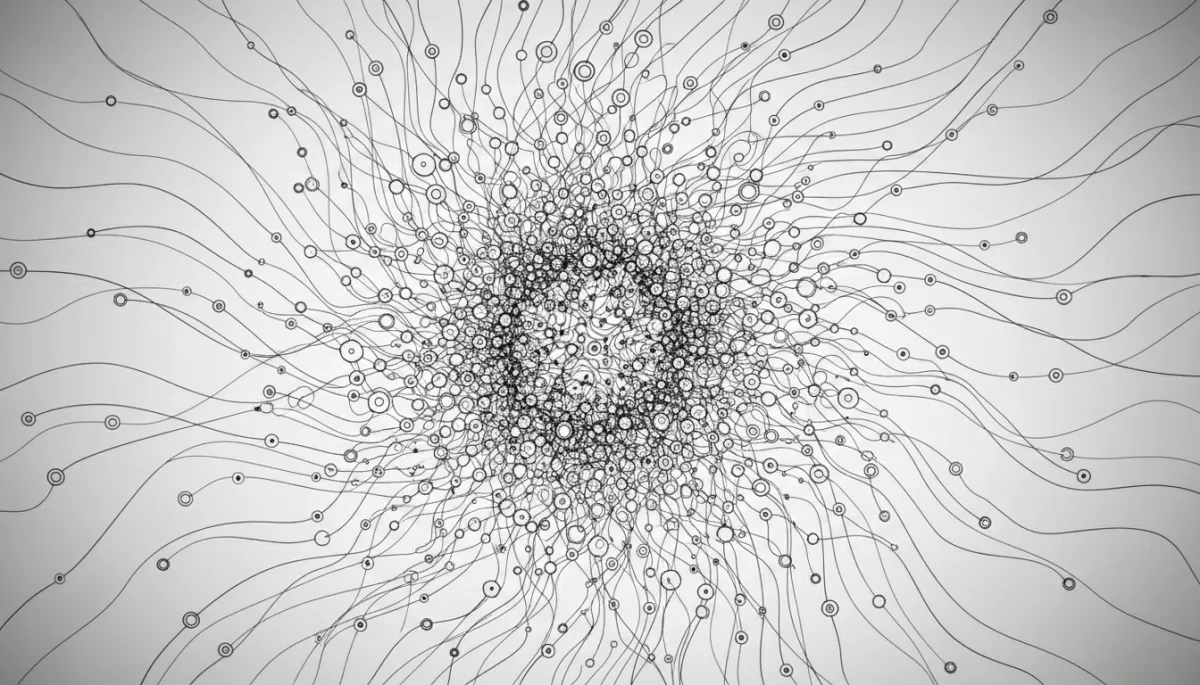
The expanding web metaphor highlights depth, pattern recognition, and rich internal connections in autistic thinking.
This autism representation is not meant to capture every autistic person’s experience, but it does offer a powerful shift in perspective. Instead of seeing autism as a lack—of social skills, flexibility, or “normal” behavior—the web shows it as a different configuration of strengths and challenges. It helps explain why some autistic people excel in pattern-heavy fields, why routines matter so much, and why seemingly small disruptions can feel enormous. Most importantly, it invites others to respond with adjustments and support, rather than criticism.
Organized Chaos: A Visual Metaphor for AuDHD
AuDHD is a term people use to describe being both autistic and ADHD. To picture it, imagine a page filled with shapes, lines, and colors that look chaotic at first glance—but if you look closer, there is structure. Some shapes repeat in patterns, some lines connect in meaningful ways, and certain areas of the page are carefully organized while others are wild and scattered. This is organized chaos: a metaphor for living at the intersection of autism and ADHD.
From the ADHD side, you might recognize the restless energy, racing thoughts, and difficulty sticking to one task. From the autistic side, you might recognize deep focus on specific interests, sensitivity to sensory input, and a strong need for structure or predictability. Put together, AuDHD can feel like having a brain that craves both order and stimulation at the same time. The result is a mind full of ideas, connections, and sensations that can be brilliant, exhausting, or both in the same day.
The organized chaos metaphor for AuDHD explanation can also highlight why life might feel confusing. You might be incredibly structured in some areas—like having detailed systems for your hobbies or work—while struggling to manage basic daily tasks. You may hyperfocus for hours, then suddenly find yourself unable to start something simple. You may crave routine, yet constantly get pulled into new interests or distractions. From the outside, this can look inconsistent. From the inside, it can feel like you are always trying to herd a hundred meaningful, buzzing thoughts into some kind of order.
💡 Pro Tip: If the organized chaos visual resonates with you, it might be helpful to explore resources created specifically by and for AuDHD people. Their strategies often blend both structure and flexibility, honoring the full picture of how their brains work.
Remember: These Visuals Are Metaphors, Not Diagnostic Tools
When you see the straight line, interrupted line, expanding web, and organized chaos side by side, it can be tempting to think, “Which one am I?” or “Which one is my child, partner, or friend?” While that curiosity is natural, it is important to keep one boundary clear: these are illustrations, not medical charts. They are meant to help you talk about experiences, not replace professional assessment or self-reflection over time.
A single person might see themselves in more than one visual. You might relate to the interrupted line when it comes to work, but to the expanding web when it comes to your special interests. You might feel mostly neurotypical in some contexts and more AuDHD in others. Human minds are complex, and no drawing—no matter how clever—can capture the full reality of your inner life. That is why these neurodiversity visuals should be used as conversation starters, not final answers.
If any of these metaphors resonate strongly with you, they can be a helpful way to explain your experience to a therapist, doctor, or trusted person in your life. You might say, “My brain feels more like the interrupted line than the straight one,” or “I think in webs, not steps.” That kind of language can open doors to more accurate support, whether or not you ever pursue a formal diagnosis.
Using Visuals to Build Compassion, Not Judgment
At the heart of these metaphors is a simple goal: more understanding and less judgment. Whether you identify as neurotypical, ADHD, autistic, AuDHD, or are still figuring it out, these visuals invite you to pause before labeling yourself or others as “difficult,” “lazy,” “too much,” or “not enough.” Instead, you can ask: “What kind of line or web might this person be working with? What kind of support would make their path easier?”
For the straight line thinker, compassion might look like recognizing that not everyone can move so predictably—and being willing to slow down or adjust expectations.
For the interrupted line, compassion might mean offering gentle reminders, flexible deadlines, or task structures that support an ADHD brain instead of punishing it.
For the expanding web, compassion could mean honoring sensory needs, allowing deep focus on interests, and giving advance notice before changing plans.
For organized chaos, compassion might look like helping to create external structure—lists, routines, tools—while respecting the person’s need for flexibility and stimulation.
When you approach neurodiversity this way, the visuals become bridges rather than barriers. Instead of sorting people into rigid categories, you can use these metaphors to say, “I may not experience the world exactly as you do, but I am willing to learn.” That willingness is often more healing than any perfectly accurate label.
Bringing It All Together: Seeing Your Own Line, Web, or Pattern
As you think about the straight line, the interrupted line, the expanding web, and the organized chaos, you might notice a quiet question forming: “Where do I fit?” It can be tempting to rush toward an answer, especially if you have spent years feeling misunderstood. Instead, consider treating these visuals as invitations to explore your own story with gentleness.
You might start by reflecting:
When do I feel most like a straight line—steady, focused, and in sync with expectations?
When does my attention feel like an interrupted line, jumping or stalling even when I care deeply?
In what areas of my life do I think in webs, making rich connections that others might miss?
Where does my mind feel like organized chaos—full of meaning, but hard to sort?
Your answers might not match any single label neatly, and that is okay. Neurodiversity is not about fitting into a perfect box; it is about recognizing that there are many legitimate ways for a brain to be. The value of these visual metaphors is not in their precision, but in their power to say, “You are not alone. There are patterns to what you are feeling. Others have walked similar paths, and there are words, images, and communities that can hold your experience.”
Moving Forward with Curiosity and Care
Whether you identify as neurotypical, ADHD, autistic, AuDHD, or are simply curious about how different minds work, you now have a small set of visual tools: a straight line, an interrupted line, an expanding web, and organized chaos. They are simple drawings, but they carry a powerful message about neurodiversity: difference is real, valid, and worthy of respect.
As you move through your day, you might quietly imagine the invisible lines and webs around you. The colleague who plans everything weeks in advance. The friend who forgets messages but lights up with creativity. The child who notices every tiny pattern in a room. The adult who seems scattered but has a mind full of carefully organized inner worlds. Each of them is carrying their own drawing, whether they know it or not.
When you remember that, it becomes easier to choose understanding over judgment. Instead of assuming “won’t,” you can consider “can’t, yet,” or “can, with support,” or “can, but in a different way.” Instead of demanding that everyone follow the same straight line, you can start asking a more generous question: What does this person’s path look like, and how can I walk beside them with respect?
In the end, that is the quiet power of these visual metaphors. They do not give you all the answers, but they help you see the questions more clearly. They remind you that behind every behavior is a brain doing its best with the wiring it has. And they offer a simple, human invitation: to meet yourself and others with a little more patience, a little more curiosity, and a lot more compassion. Get the workbook here
