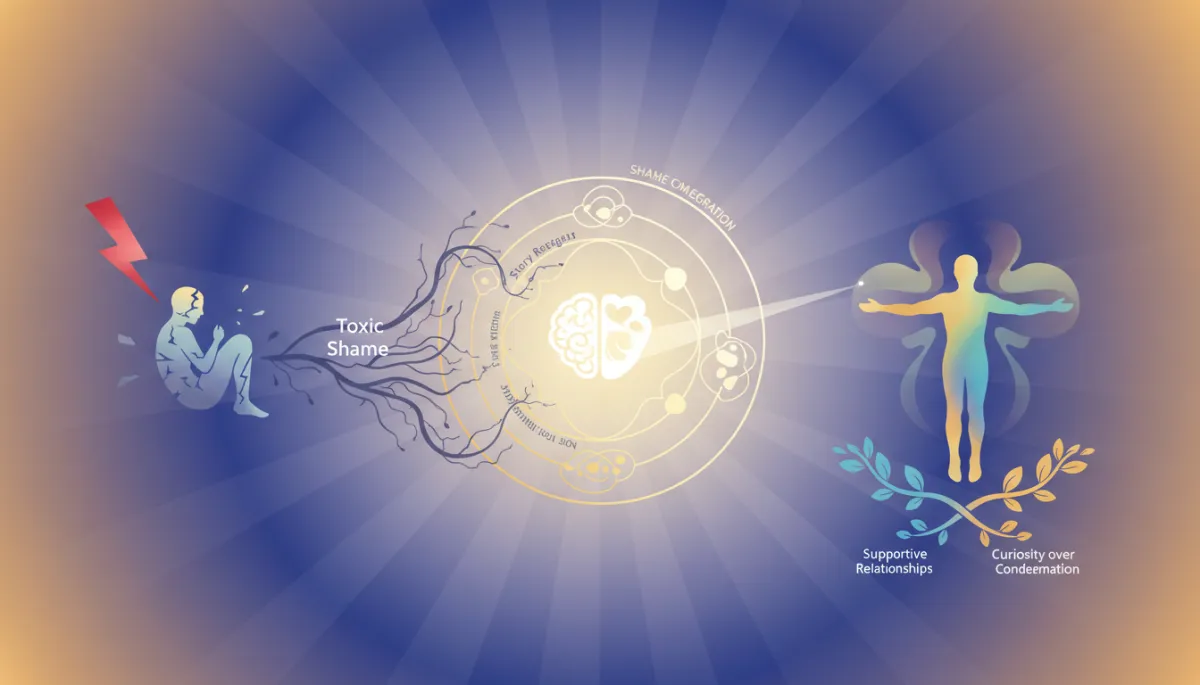
Understanding Shame: From Trigger to Integration
Mental Health, Shame Integration, Emotional Healing
Understanding How Shame Moves from Trigger to Integration
Shame is one of the most painful human emotions, yet it is also one of the least understood. When we learn how shame moves through us—from the first spark of a trigger to a place of integration—shame stops being a silent dictator and becomes a doorway to deeper self-compassion and emotional healing.
Understanding Shame: From Human Emotion to Toxic Burden
To begin any journey of Shame Integration, we first need a clear, compassionate understanding of shame itself. Shame is a social emotion. At its healthiest, it is a built-in signal that helps us recognize when we’ve stepped outside our values or hurt others, and it nudges us back toward connection, repair, and responsibility. This kind of shame is uncomfortable, but it is not destructive. It says, “Something I did may be out of alignment,” not “I, as a person, am worthless.”
Author and therapist John Bradshaw calls this healthy shame—a natural limit-setting emotion that reminds us we are human and imperfect. Healthy shame helps us stay humble, accountable, and connected. It keeps our ego in check and makes genuine repair possible when we’ve made a mistake. In this sense, shame can actually support integrity and authentic relationships.
But there is another form of shame that Bradshaw and many trauma therapists describe: toxic shame. Toxic shame is not about what we did; it is about who we believe we are. Instead of “I did something wrong,” toxic shame whispers, “I am something wrong.” It fuses our sense of self with the feeling of defectiveness. Over time, this becomes a lens through which we see everything—our past, our relationships, and our future possibilities.
Feeling Shame vs. Being Shameful: A Vital Distinction
One of the most powerful shifts in shame integration is learning the difference between feeling shame and being shameful. Feeling shame is an emotional experience—often intense, hot, and overwhelming. Being shameful is an identity conclusion, a belief that shame defines your entire being. The first is a passing emotional state; the second is a deeply rooted story about who you are at your core.
When we say, “I feel ashamed,” we are naming an emotion. That emotion can be explored, soothed, and understood. When we say, “I am shameful,” we are collapsing our entire self into that emotion. We are no longer a whole, complex person who sometimes feels shame; we are, in our own mind, the embodiment of shame. This is the territory of toxic shame, and it is often rooted in early life experiences where we were not only corrected for our behavior but judged, mocked, or abandoned for who we were.
💡 Key Insight: Emotions are experiences, not identities. You can feel shame without being shameful. This distinction creates space for healing.
How Shame Develops: Modeling, Emotional Abandonment, and Abuse
Our relationship with shame rarely begins in adulthood. It is usually shaped in childhood, long before we have words for what we feel. John Bradshaw and other family systems thinkers emphasize that children learn about themselves through the responses of their caregivers. When those responses are shaming, chaotic, or neglectful, shame can take root and become toxic over time.
1. Modeling: Absorbing Shame from the Adults Around Us
Children are keen observers. They watch how parents talk about themselves, handle mistakes, and respond to vulnerability. If a caregiver constantly calls themselves “stupid,” “useless,” or “a failure,” the child learns that imperfection is something to despise. If a parent explodes in rage when they make a mistake, the child internalizes the idea that errors are dangerous and unforgivable. This is modeling: we absorb not only what is said to us, but what is said around us and about us.
Over time, a child who witnesses chronic self-hatred or severe self-criticism may begin to believe, “This is how I should treat myself too.” Healthy shame says, “I made a mistake, and I can repair it.” Modeled toxic shame says, “I made a mistake, therefore I am a mistake.” Without anyone needing to say it out loud, the child learns to attach shame directly to their identity.
2. Emotional Abandonment: When Feelings Are Ignored or Mocked
Another powerful source of toxic shame is emotional abandonment. This does not always look like physical neglect. A child can be clothed, fed, and taken to school, yet feel deeply alone inside. Emotional abandonment happens when a child’s inner world—feelings, needs, fears, joys—is consistently dismissed, minimized, or ridiculed. Phrases like “Stop crying or I’ll give you something to cry about,” “You’re too sensitive,” or “Don’t be ridiculous, that’s nothing,” send a clear message: your feelings are wrong, and by extension, something is wrong with you for having them.
When this happens repeatedly, the child learns that their authentic self is unwelcome. They may begin to hide their emotions, shut down their needs, and present only the parts of themselves that feel “acceptable.” Inside, though, they often carry a heavy sense of defectiveness. They don’t just think, “My feelings are too much”; they think, “I am too much. I am wrong at the core.” This is toxic shame taking up residence in the psyche.
3. Abuse: Shame as a Weapon and a Survival Strategy
Physical, sexual, and emotional abuse are some of the most potent breeding grounds for toxic shame. Abusers often project their own unresolved shame onto their victims, using humiliation, blame, and degradation as tools of control. A child who is abused is rarely told, “This is not your fault.” More commonly, they are told—directly or indirectly—“You made me do this,” “You’re disgusting,” or “No one would believe you anyway.” The child’s nervous system, desperate to survive and maintain some sense of order, often concludes, “It must be me. I must be the problem.”
In this way, shame becomes a survival strategy. If the child can believe they are bad, then perhaps the world still feels somewhat predictable: “If I can just be better, quieter, less needy, this will stop.” Tragically, this strategy carries forward into adulthood, long after the original danger has passed. The person may continue to blame and attack themselves for everything that goes wrong, reinforcing the old belief: “I am fundamentally shameful.”

Safe, attuned relationships create the conditions where toxic shame can finally begin to heal.
The Four Levels of Shame Progression: From Trigger to Integration
To move toward shame integration, it helps to map how shame actually progresses within us. We can think of this as four interconnected levels:
The Trigger
The Body Response
The Story and Belief
The Integration
Level 1: Shame Triggers – When the Spark Is Lit
Shame triggers are the situations, words, expressions, or memories that ignite the feeling of shame. They can be obvious—like receiving harsh criticism at work—or subtle, such as a partner’s brief silence, a friend not texting back, or seeing someone else succeed in an area where you feel insecure. The trigger itself is not the whole story; it is simply the spark that touches an already-sensitive place inside you.
Two people can experience the same event and have completely different shame responses. This is because shame triggers are deeply personal and often rooted in our history. If you grew up being mocked for your body, a casual comment about appearance might feel like a direct attack. If you were shamed for crying, even kind feedback might register as “You’re too much.” Recognizing your specific shame triggers is an important step in understanding shame and beginning to relate to it differently.
Level 2: Body Response – How Shame Feels in the Nervous System
Before we even have words for what’s happening, shame shows up in the body. You might feel your face flush, your stomach drop, your chest tighten, or your gaze fall to the floor. Some people describe wanting to disappear, hide, or “sink through the ground.” Others feel numb, frozen, or suddenly very small inside. These are all signs that your nervous system is responding to a perceived threat to belonging and safety.
This body response is not a sign of weakness; it is a sign of how deeply wired we are for connection. From an evolutionary perspective, being cast out of the group could mean death. Shame is the emotion that warns us we might be at risk of disconnection. When we notice our body’s reaction with curiosity instead of condemnation, we begin to create a little space between ourselves and the shame. We can say, “My chest is tight and I want to hide. Something in me feels unsafe,” rather than, “I’m pathetic for feeling this way.”
💡 Curiosity Practice: Next time you feel a surge of shame, pause and gently ask, “Where do I feel this in my body?” and “What might this part of me be trying to protect?”
Level 3: Story and Belief – The Inner Narrative of Toxic Shame
After the trigger and body response, the mind quickly moves in with a story. This is where toxic shame often takes over. The story might sound like:
“Of course they’re upset. I always ruin everything.”
“If people really knew me, they would leave.”
“I’m too much. I’m not enough. I’m fundamentally broken.”
These stories are rarely new. They are echoes of earlier experiences—moments of modeling, emotional abandonment, or abuse—that became encoded as beliefs about who we are. In Bradshaw’s terms, healthy shame allows us to say, “I made a mistake, and I can repair it.” Toxic shame insists, “I am the mistake, and there is no repair.” The inner critic, fueled by toxic shame, speaks in absolutes and exaggerations, leaving no room for nuance or growth.
Part of shame integration is learning to recognize these stories as stories—not as facts. This does not mean dismissing or bypassing them. Instead, we bring self-compassion and curiosity to them: “Of course I think this way; these beliefs protected me once. But are they true now? Are they helpful now?” This gentle questioning begins to loosen the grip of toxic shame and opens the door to new, more life-giving beliefs.
Level 4: Integration – Moving from Self-Attack to Self-Compassion
Integration is not about never feeling shame again. Instead, it is about changing our relationship with shame. When shame is integrated, it becomes one emotion among many, rather than a defining identity. We can notice it, listen to what it is trying to tell us, and respond with care instead of collapse or attack. Integrated shame might say, “I feel bad about how I spoke to my partner. I want to apologize and repair,” instead of, “I’m a terrible person who doesn’t deserve love.”
Practically, integration looks like:
Recognizing when shame has been triggered.
Regulating the body’s response with grounding, breath, or movement.
Reframing the old stories with more compassionate, realistic beliefs.
Repairing when needed—making amends without collapsing into self-hatred.
Over time, this process transforms shame from a force that isolates and crushes into a signal that invites honesty, accountability, and deeper connection—with ourselves and others.
The Role of Self-Compassion in Healing Shame
At every level of shame progression, self-compassion is the antidote to toxic shame. Where shame says, “You are unworthy,” self-compassion says, “You are human.” Where shame isolates, self-compassion moves toward the hurting part of you with warmth and care. This is not self-pity or self-indulgence; it is a courageous willingness to stay with your own pain instead of abandoning yourself the way others may have abandoned you in the past.
Practicing self-compassion in the context of shame could sound like:
“Of course this feels overwhelming. Given what I went through, it makes sense that this would hurt.”
“I am allowed to make mistakes and still be worthy of love and respect.”
“I’m learning. I don’t have to get this perfect to be okay.”
These responses do not erase responsibility. In fact, self-compassion often makes it easier to take responsibility because we are no longer terrified that one mistake will confirm our worst fears about ourselves. Instead of collapsing into “I am shameful,” we can stay steady in “I am a person who sometimes feels shame—and I am still worthy of care.”
Emotional Healing Is Slow, Safe, and Relational
Because shame often develops in relationship—with caregivers, peers, and partners—it is rarely healed in isolation. Emotional healing from toxic shame tends to be slow and relational. This means we need spaces where we can bring our raw, unedited selves and still be met with respect, care, and honest feedback. Therapy, support groups, trauma-informed coaching, and deeply trustworthy friendships can all become containers where shame begins to soften.
In these supportive relationships, we experience something different from what we knew before:
We share a story we’ve always hidden, and instead of rejection, we receive empathy.
We express anger or grief and are not shamed for “being too much.”
We make a mistake, own it, and are still welcomed and valued.
Each of these experiences sends a new message to the nervous system: “You can be imperfect and still belong.” Over time, these corrective experiences begin to rewrite the old shame-based narratives. But this process cannot be rushed. The nervous system needs repetition, consistency, and safety to trust that the new story is real. That is why slow, safe healing within supportive relationships is so essential for shame integration.
💡 Gentle Reminder: Healing shame is not about forcing yourself to “get over it.” It is about allowing yourself to be met, again and again, with kindness where there used to be judgment.
Choosing Curiosity Over Condemnation
One of the most practical shifts you can make in your daily life is to replace internal condemnation with curiosity. Condemnation sounds like, “What’s wrong with me?” or “I can’t believe I did that, I’m hopeless.” Curiosity sounds like, “What just happened?” “What am I feeling right now?” or “Where might this be coming from?” Both are responses to pain, but only one opens a path toward understanding and change.
When a shame trigger shows up, you might try asking yourself:
“What exactly was the moment I started to feel that drop in my stomach?”
“Does this feeling remind me of something earlier in my life?”
“If this part of me could speak, what might it say it’s afraid of?”
These questions do not magically erase shame, but they gently turn you toward yourself rather than against yourself. Over time, this posture of curiosity becomes a powerful part of your emotional healing toolkit. Instead of piling more shame on top of shame, you begin to meet your pain with interest, respect, and care.
Building a Compassionate Relationship with Yourself
Ultimately, shame integration is about more than managing triggers or calming your body. It is about developing an entirely new kind of relationship with yourself—one based on compassion rather than contempt. This relationship is not built overnight; it grows through many small, consistent choices to show up for yourself in kinder ways.
Some simple practices that support this compassionate relationship include:
Gentle self-talk: Noticing when your inner voice becomes harsh and intentionally softening it, as you would for a dear friend.
Honoring limits: Recognizing that you are human, with finite energy and capacity, and allowing rest without calling yourself lazy or weak.
Owning mistakes without self-erasure: Saying, “I did this, I regret it, and I’m committed to doing better,” instead of spiraling into “I’m a horrible person.”
Seeking support: Allowing yourself to lean on others, ask for help, and receive care without deciding that needing support makes you weak or shameful.
As you practice these skills, the old equation—“Feeling shame = being shameful”—begins to break apart. You start to experience yourself as someone who has feelings, stories, and history, but is not defined by any one of them. This is the heart of shame integration: you reclaim your wholeness from the grip of toxic shame and step into a more spacious, humane way of being with yourself.
Moving Forward: Walking with Shame Instead of Running from It
Shame is not a sign that you are broken beyond repair. It is a sign that you are human, wired for connection, and carrying stories that were often written long before you had a choice. By understanding how shame moves—from trigger, to body response, to story and belief, and finally to integration—you can begin to meet it with awareness instead of fear. You can recognize when toxic shame is speaking and gently invite in a different voice: one of self-compassion, curiosity, and truth.
Healing shame takes time. It asks for slow, safe, supportive relationships—with others and with yourself. It invites you to trade condemnation for curiosity, and self-attack for tenderness. As John Bradshaw and many others have shown, when shame is brought into the light of compassion, it loses its power to define us. We remember that we are more than our worst moments, more than our old stories, and certainly more than the lies we were told about our worth.
You do not have to walk this path alone. Whether through therapy, trusted friendships, or quiet moments of honest reflection, you can begin—step by gentle step—to transform your relationship with shame. In doing so, you open the door to deeper emotional healing, more authentic connection, and a life guided not by fear of being “shameful,” but by a grounded sense of your inherent dignity and worth.
